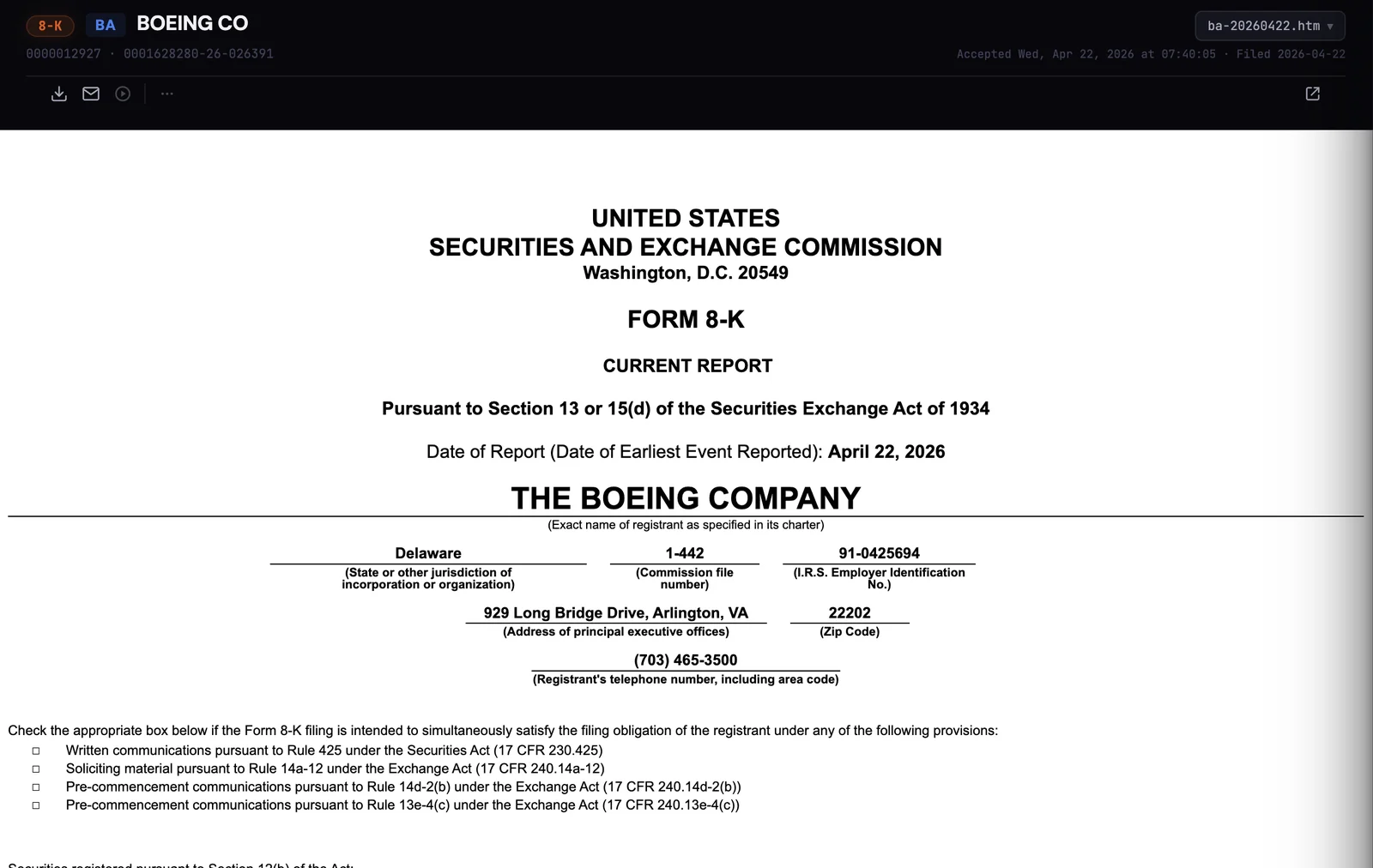
An 8-K is the form a public company files when something happens that investors should know about before the next quarterly report. Unlike the 10-K and 10-Q, it isn’t scheduled — it’s triggered by a specific event, and it’s generally due within four business days of that event.
Each kind of event has its own item number. There are about thirty of them, organized into nine numbered sections. The item number is the most useful thing on the cover: it tells you what the filing is about before you read a word of the body. This page is the full index — every item, what it discloses, and which ones tend to matter most.
Section 1 — Business and operations
| Item | Title | What it discloses |
|---|---|---|
| 1.01 | Entry into a Material Definitive Agreement | A new material contract — a merger agreement, a credit facility, a major supply deal. Often the first public sign of a transaction. |
| 1.02 | Termination of a Material Definitive Agreement | A material contract ending — a deal falling through, a facility being repaid or cancelled. |
| 1.03 | Bankruptcy or Receivership | The company entered bankruptcy or receivership. |
| 1.04 | Mine Safety — Shutdowns and Patterns of Violations | Mine-safety orders. Narrow, industry-specific. |
| 1.05 | Material Cybersecurity Incidents | A material cyber incident, with the nature, scope, and impact — required since late 2023. Due four business days after the company determines materiality. |
Section 2 — Financial information
This section carries some of the highest-signal items in the form — especially for credit.
| Item | Title | What it discloses |
|---|---|---|
| 2.01 | Completion of Acquisition or Disposition of Assets | A deal closed (the 1.01 was the agreement; this is the close). |
| 2.02 | Results of Operations and Financial Condition | The earnings release. The most common 8-K item by volume. |
| 2.03 | Creation of a Direct Financial Obligation | New debt — a drawn credit facility, a note issuance, a material off-balance-sheet obligation. |
| 2.04 | Triggering Events That Accelerate a Direct Financial Obligation | A covenant breach or default that accelerates debt. A direct credit-stress signal. |
| 2.05 | Costs Associated with Exit or Disposal Activities | Restructuring — layoffs, plant closures, the charges that come with them. |
| 2.06 | Material Impairments | A material write-down of assets or goodwill. |
Section 3 — Securities and trading markets
| Item | Title | What it discloses |
|---|---|---|
| 3.01 | Notice of Delisting or Failure to Satisfy a Listing Rule | The exchange flagged a listing-standard problem, or the company is being delisted. |
| 3.02 | Unregistered Sales of Equity Securities | A private placement or other unregistered issuance — watch for dilution. |
| 3.03 | Material Modification to Rights of Security Holders | A change to the terms of existing securities. |
Section 4 — Accountants and financial statements
Both items here are red-flag territory.
| Item | Title | What it discloses |
|---|---|---|
| 4.01 | Changes in Registrant’s Certifying Accountant | The auditor changed. Worth reading for why — a dismissal after a disagreement is very different from a routine rotation. |
| 4.02 | Non-Reliance on Previously Issued Financial Statements | A restatement — prior financials can no longer be relied on. One of the strongest single adverse signals in the form. |
Section 5 — Corporate governance and management
| Item | Title | What it discloses |
|---|---|---|
| 5.01 | Changes in Control of Registrant | Control of the company changed hands. |
| 5.02 | Departure / Election of Directors or Officers; Compensatory Arrangements | A CEO, CFO, or director leaving or arriving — plus pay arrangements. High-volume and high-signal; the abruptness and timing are the tell. |
| 5.03 | Amendments to Articles or Bylaws; Change in Fiscal Year | Charter/bylaw changes or a fiscal-year shift. |
| 5.04 | Temporary Suspension of Trading Under Employee Benefit Plans | A blackout period for plan participants. |
| 5.05 | Amendments to or Waiver of the Code of Ethics | A change to — or a waiver of — the code of ethics. A waiver for a named executive is worth a look. |
| 5.06 | Change in Shell Company Status | The company is no longer (or is now) a shell — common around reverse mergers. |
| 5.07 | Submission of Matters to a Vote of Security Holders | Shareholder-meeting voting results. |
| 5.08 | Shareholder Director Nominations | Notice related to shareholder board nominations. |
Section 6 — Asset-backed securities
Specialized items for ABS issuers (6.01–6.05): informational and computational material, change of servicer or trustee, change in credit enhancement, failure to make a required distribution, and Securities Act updating disclosure. Relevant if you work in structured products; otherwise rare.
Sections 7, 8, and 9 — disclosure, other, and exhibits
| Item | Title | What it discloses |
|---|---|---|
| 7.01 | Regulation FD Disclosure | Information furnished (not filed) under Reg FD — investor decks, selective-disclosure cures. |
| 8.01 | Other Events | The catch-all. Anything the company chooses to disclose that doesn’t fit elsewhere — and sometimes the most interesting item on a filing. |
| 9.01 | Financial Statements and Exhibits | The exhibit list. Where the actual press release, agreement, or presentation referenced by the other items is attached. |
How to read the item codes in practice
A single 8-K usually carries more than one item. A merger closing might file 2.01 (completion), 5.02 (the departing CEO of the acquired company), and 9.01 (the agreement as an exhibit) together. Read the items in combination — the set of codes on a filing is the shape of the event.
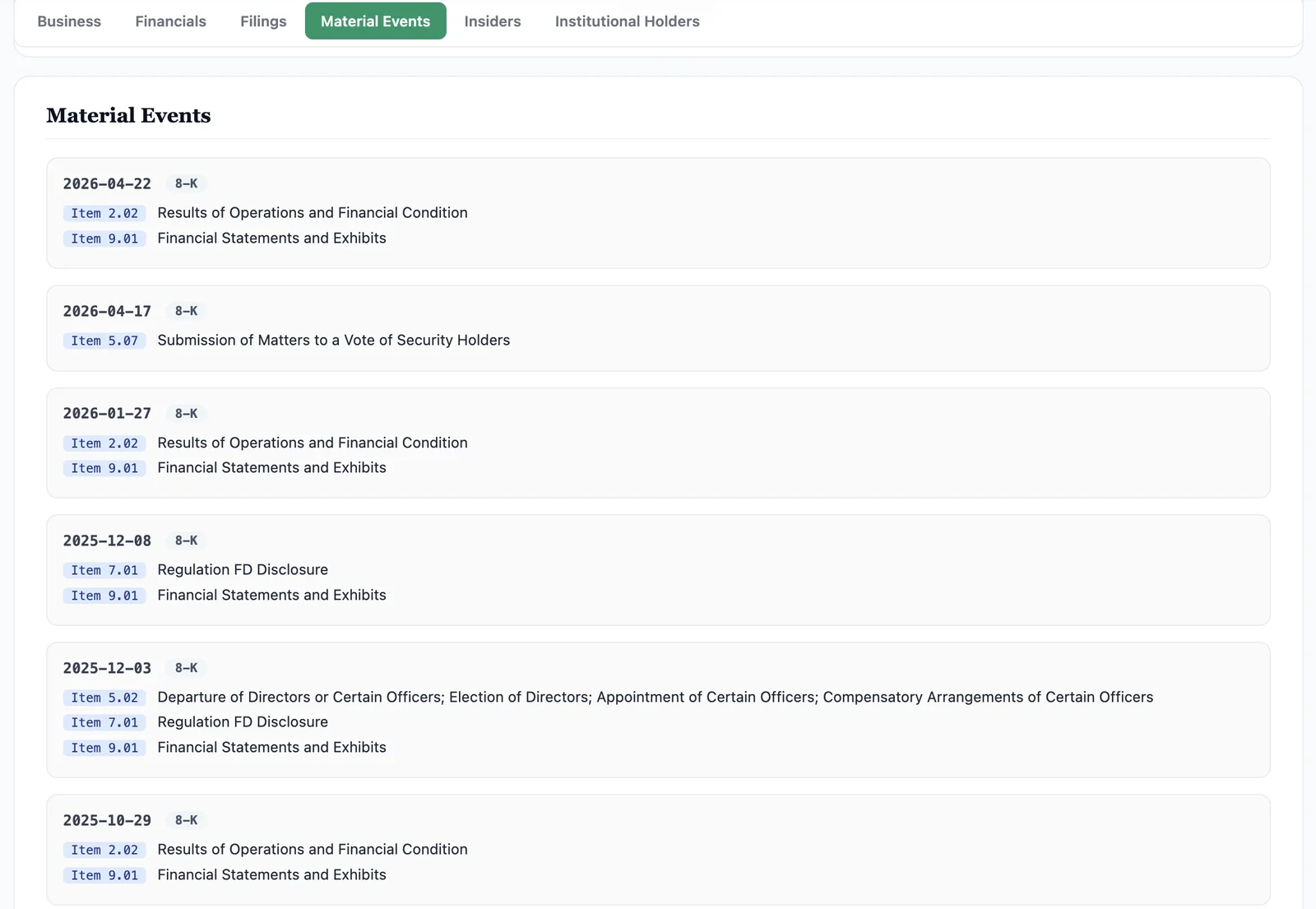
For triage, a useful mental tiering:
Usually high-signal
- 4.02 restatement
- 2.04 / 2.06 default / impairment
- 1.05 cyber incident
- 5.02 abrupt executive exit
Usually routine
- 2.02 earnings release
- 5.07 voting results
- 7.01 furnished disclosure
- 8.01 (depends entirely on the body)
The codes don’t tell you severity on their own — a 5.02 can be a planned retirement or a sudden firing. But they tell you what to read first, and across a watchlist they let you filter thousands of filings down to the handful worth your attention.
That filtering is what edgar.tools automates. Pull any company’s 8-Ks by item on its disclosures page, or set a Sentinel to watch specific items across a peer set and get an AI-analyzed brief the day they file.
New to SEC forms? Start with the SEC filing types guide, or read any company’s 8-Ks free at app.edgar.tools.