When an investor crosses 5% ownership of a public company’s voting stock, the SEC requires them to come out of the shadows and file a beneficial-ownership report. There are two flavors — Schedule 13D and Schedule 13G — and which one gets filed tells you almost everything about the investor’s intent.
The short version: 13D is the activist form, 13G is the passive form. A 13D says “I own a big stake and I may try to influence this company.” A 13G says “I own a big stake and I’m a long-term or institutional holder with no such plans.” Same 5% trigger, very different signal — and, since 2024, very different (and shorter) deadlines.
Schedule 13D — the activist filing
- Filed by investors who intend to influence control
- Far more detailed: plans, purpose, financing, contacts
- Initial filing due in 5 business days
- Amendments due within 2 business days of a material change
Schedule 13G — the passive filing
- Filed by passive holders, institutions, and exempt investors
- Short form — no statement of plans or intent to control
- Deadlines vary by filer type (see below)
- Amendments on a quarterly cadence, with faster triggers
The 5% threshold
Both schedules are triggered the same way: when a person or group becomes the beneficial owner of more than 5% of a class of voting equity securities registered under Section 12 of the Exchange Act. Beneficial ownership includes shares you have the right to acquire within 60 days (options, convertibles), and a “group” acting together aggregates its members’ holdings — so two funds coordinating a stake can’t each stay under 5% to avoid filing.
Once you’re over the line, the only question is which schedule — and that turns on intent.
The intent test — what decides 13D vs 13G
The dividing line is whether you hold the stake with the purpose or effect of changing or influencing control of the company.
- Intend to influence control → Schedule 13D. Pushing for board seats, a sale, a strategic change, a proxy fight. This is the activist’s filing, and it’s the one event-driven desks watch.
- No such intent → Schedule 13G is available, and it splits into three filer categories:
- Qualified Institutional Investors (QIIs) — registered institutions (broker-dealers, banks, registered investment advisers, insurance companies) holding in the ordinary course of business without control intent.
- Passive Investors — anyone holding under 20% with no control intent, regardless of institutional status.
- Exempt Investors — those who held over 5% before the company’s registration, or otherwise qualify for an exemption.
The 2024 deadline changes
The SEC overhauled these deadlines in rules adopted in late 2023, and they’re now in force. The headline: everything got faster.
Schedule 13D (compliance date February 5, 2024):
- Initial 13D: within 5 business days of crossing 5% — down from the old 10 calendar days.
- Amendments: within 2 business days of a material change — replacing the old, vaguer “promptly.”
Schedule 13G (compliance date September 30, 2024) — deadlines depend on filer type:
| Filer type | Initial 13G | Key amendment trigger |
|---|---|---|
| Qualified Institutional Investor | 45 calendar days after the quarter-end in which it exceeded 5%; 5 business days after month-end if it exceeds 10% | 5 business days after month-end on a 5%+ move once above 10% |
| Passive Investor | 5 business days after exceeding 5% | 2 business days after exceeding 10%, then on each 5%+ move |
| Exempt Investor | 45 calendar days after the quarter-end in which it exceeded 5% | 45 days after quarter-end on a material change |
The other structural change: routine 13G amendments moved from an annual cadence to 45 days after the end of any calendar quarter in which a material change occurred. In practice, 13G holdings now refresh four times a year instead of once.
Reading 13D/13G filings on edgar.tools
Both schedules — and their amendments — flow through EDGAR, and edgar.tools parses them into structured ownership records on the company page: who crossed 5%, how much they hold, and whether the filing is the activist 13D or the passive 13G. The activist-signal layer flags the moves that matter most — a fresh 13D, or a 13G-to-13D flip on a name you’re watching.
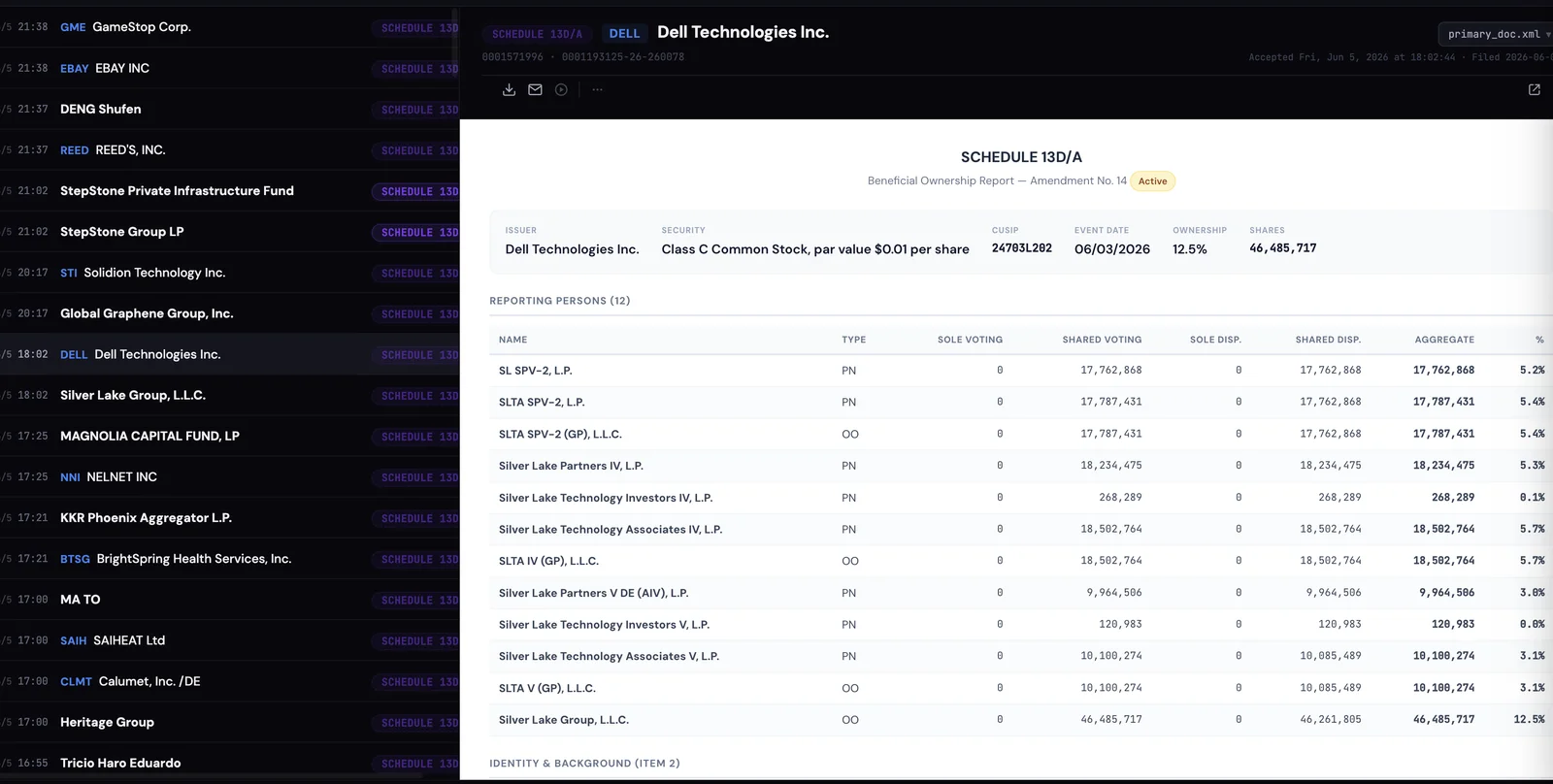
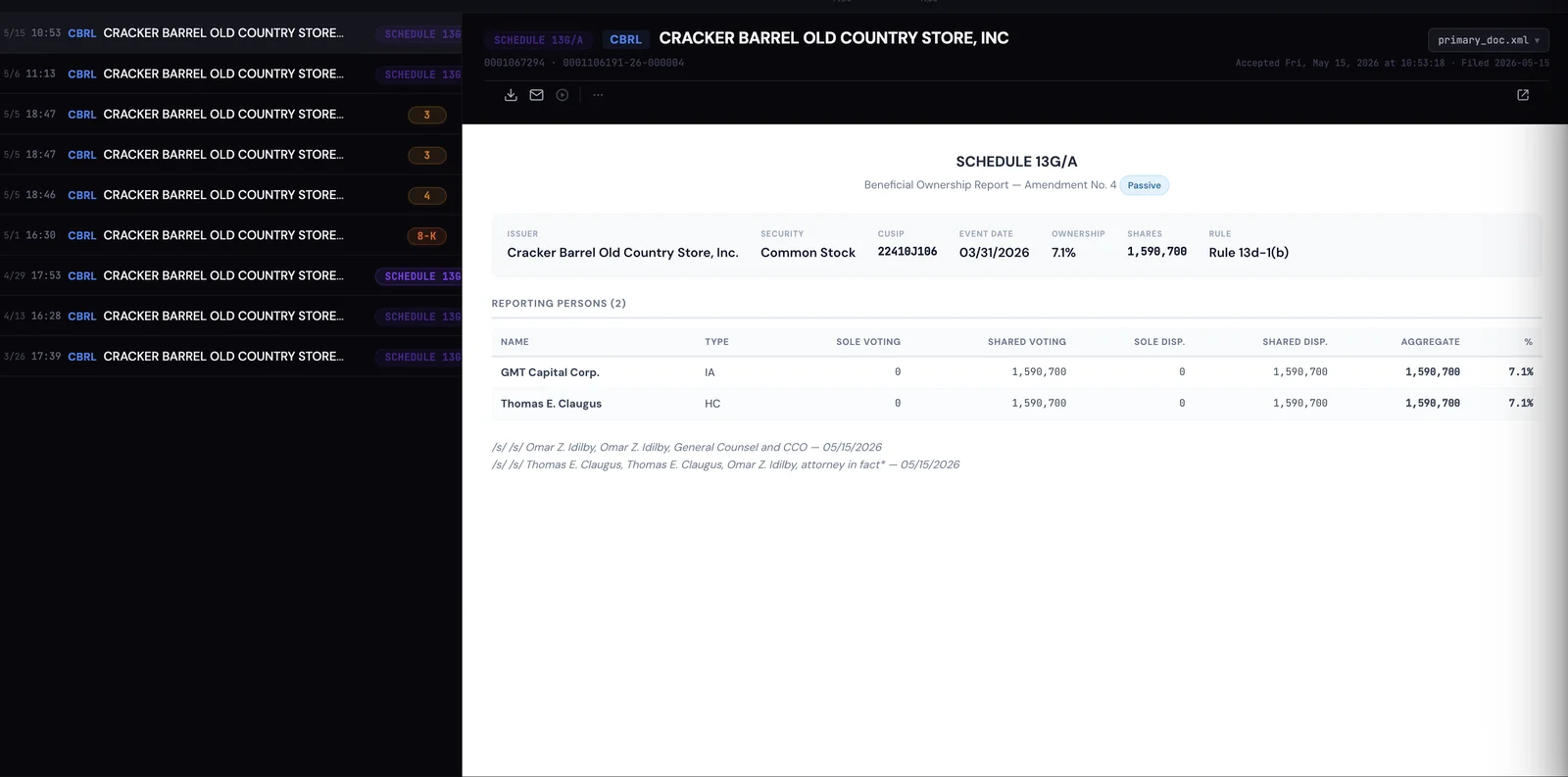
If you’d rather not check by hand, a Sentinel can watch 13D/13G activity across a peer set or watchlist and deliver an AI-analyzed brief the day a stake goes public.
New to SEC forms? Start with the SEC filing types guide, or track beneficial ownership free at app.edgar.tools.